Programs & Events Coordinator Armonee Wilkins investigates the role of coats in recruiting and sustaining Revolutionary War soldiers.
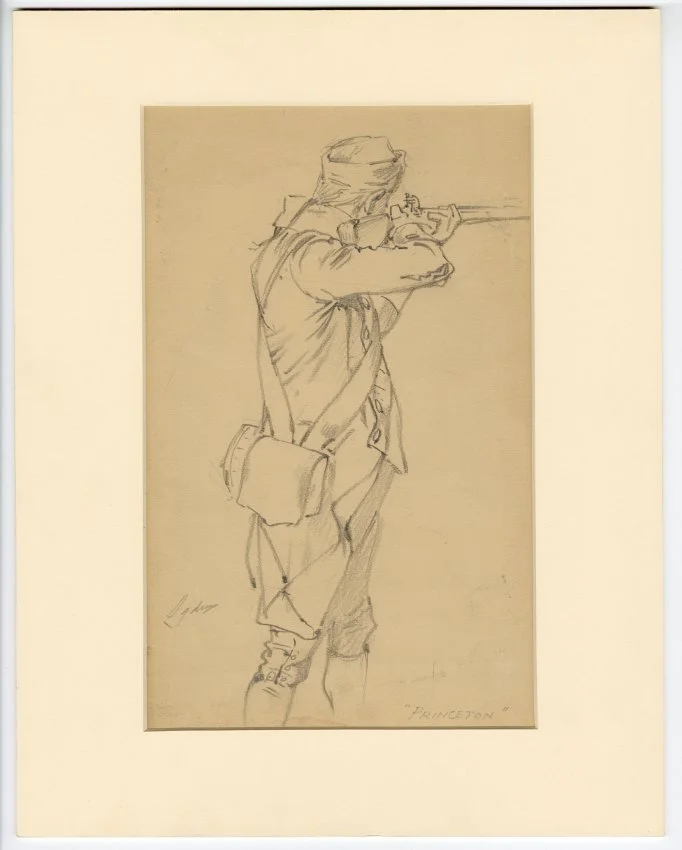
Courtsey of Fraunces Tavern Museum
Included among the objects in the Path to Liberty: The Emergence of a Nation exhibition is a very informative drawing of a Continental soldier in Princeton drawn by Henry Alexander Ogden, a military artist based in Brooklyn during the mid-1800s. At first glance, it seems that this image is just a simple picture of a Continental soldier. However, when you look more deeply into it, the torn part of his coat becomes very noticeable, revealing the difficulty of clothing the Continental Army.
Today, one might consider a torn coat to be nothing more than a minor problem. In the context of the American Revolution, however, a coat was an expensive, even rare item. The fact that this soldier is wearing a torn coat indicates one of the many problems that faced General George Washington’s troops – providing clothing for his men.
One Coat Per Soldier
From the first phase of the war, the Army issued one coat to an average enlisted soldier. The Continental Congress, for instance, provided a coat along with other items in its bounty to enlistees in the latter part of October 1775 [1]. The coat, in some cases, appears to have played a meaningful role in recruitment and retention, “military leaders recognized that men were more likely to enlist before… they feel the hardships of a winter campaign,” making adequate clothing an important incentive for service [2].
However, the importance of a coat can be clearly understood from the military record of that fall. As General Orders dated 28 October 1775 reveal, the soldiers had been granted a certain percentage of their salaries so that they could get cloth made into "a Uniform Coat, and Waistcoat."[3] In other words, unlike the free provision of clothing by the army, soldiers were supposed to purchase their uniforms from their salary. As Washington's General Orders of 12 November revealed, the army was determined to follow this trend [4].
Clothing as Currency
Furthermore, the importance of the coat is proven by the trial proceedings of a court-martial conducted on November 17, 1775. The accused was charged with cheating soldiers not only for their "coat money" but also for their "blanket money."[5] This charge was unlikely to be of much consequence if the coats had been plentiful.
There were also frequent problems with receiving payments from the army. Washington asked Congress for money to pay the soldiers’ salaries and give one month’s salary in advance on November 20, 1775 [6]. Because of the delay in payments, it became very hard to buy the necessary supplies. Unable to receive their money, the soldiers also couldn’t obtain coats.
The Tailors Go to War
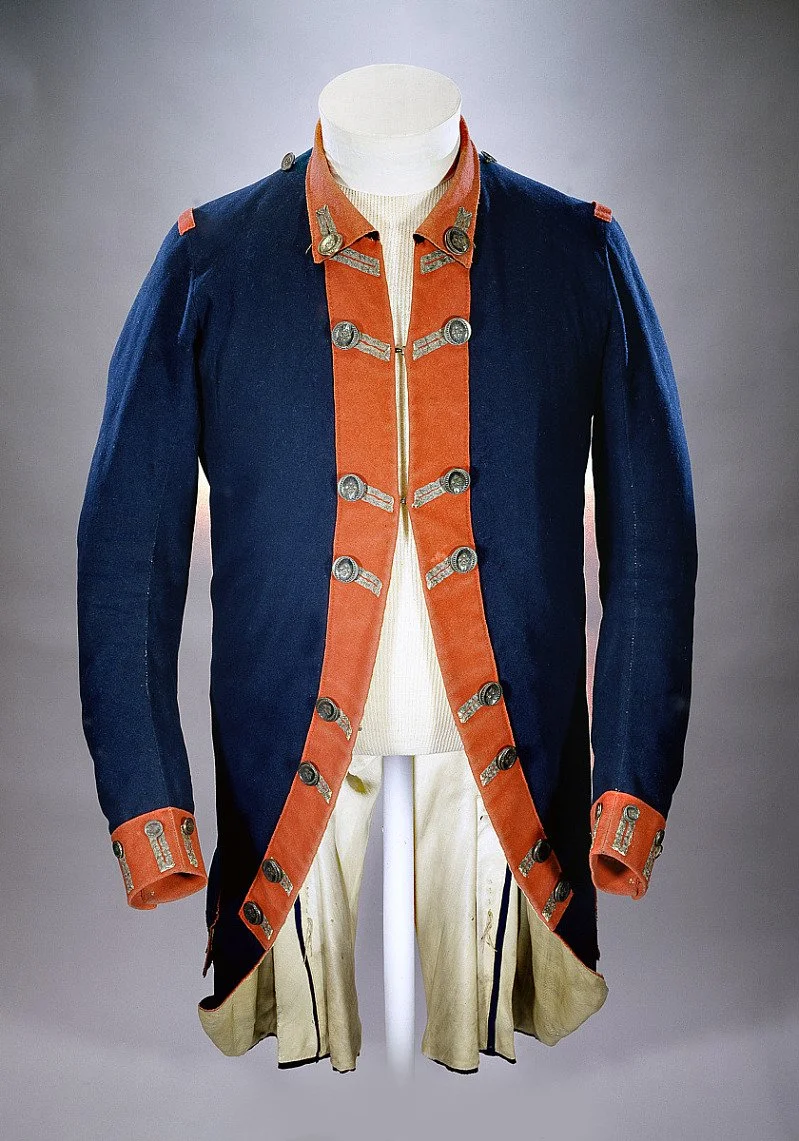
Regimental Uniform Coat of Colonel Peter Gansevoort Jr.
Courtsey of National Museum of American History
The clothing problem became acute in late 1776 when Robert Morris, a prominent Philadelphia merchant and Pennsylvania delegate in the Continental Congress [7], wrote to Washington that he had told tailor James Mease to accelerate the manufacture of clothing for the troops.[8] The shortage persisted despite the efforts made in this regard. As it turned out, the root of the problem was not difficult to discern; most of the tailors in the area had already left to join the army.
In the words of Morris, "most of the Taylors are at the Camp," meaning that tailoring work in camp was in such high demand that skilled labor had been transferred away from the civilian manufacture of clothing.[9]
In some cases, even though materials were plentiful, a lack of manpower prevented their conversion into useful uniforms.
A Continental Shortage
The difficulties faced by soldiers during the fall and winter of 1776 caused Congress to seek foreign aid. In February 1777, the Secret Committee of Congress asked France to supply them with forty thousand uniforms to be worn by soldiers before the upcoming winter campaign season.[10]
The Secret Committee provided their rationale for seeking such assistance in no uncertain terms: the army was "considerably ... distressed last Fall and during this Winter from the unsatisfactory mode in which our Soldiers were clothed."[11] Adequate clothing for soldiers within the Continental Army did not simply constitute comfort but also the well-being of the soldiers.
Looking at the Princeton Sketch
In this context, the torn coat in the sketch of the Princeton soldier becomes something more than simply a piece of artistic description; it is a clear example of the difficulties suffered by common people in their efforts to participate in the American Revolution.
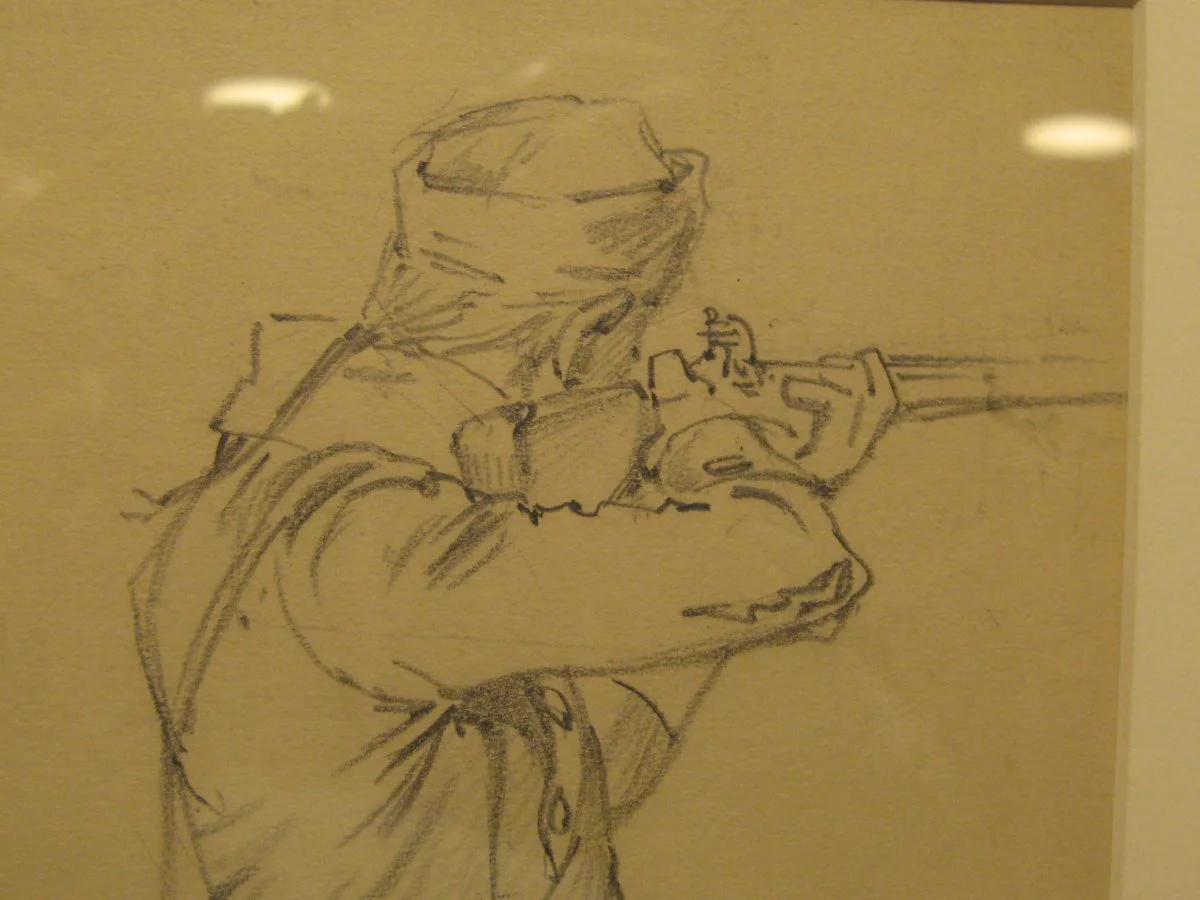
Closeup of the ripped Coat, Courtesy of the Fraunces Tavern Museum
Every tear, fray, and stain symbolizes a bigger story about insufficient support, postponed payments, problems with production, and the general difficulty of maintaining an army in a freshly established country. The Princeton soldier, who carried all necessary goods with himself, could not avoid having his coat damaged because of prolonged marches, exposure to harsh conditions, and general difficulty in obtaining decent clothing under these circumstances.
In Path to Liberty: The Emergence of a Nation, Henry Alexander Ogden’s sketch of the Princeton soldier is a reminder that the battle for American Independence entailed more than victories in important battles; it also included the struggles of soldiers who had to endure deprivation for the sake of the war effort. Sometimes, the tale told by torn clothes becomes just as significant as the story of success on the battlefield.
References
[1] Journals of the Continental Congress, October 26, 1775,
[2] Report of the Committee of Conference, October 1775.
[3] George Washington, General Orders, October 28, 1775.
[4] George Washington, General Orders, November 12, 1775.
[5] George Washington, General Orders, November 17, 1775.
[6] George Washington, General Orders, November 20, 1775.
[7] Office of the Historian, U.S. House of Representatives, “MORRIS, Robert (1734–1806),” Biographical Directory of the United States Congress,
[8] Robert Morris to George Washington, December 23–24, 1776.
[9] Robert Morris to George Washington, December 23–24, 1776.
[10] Secret Committee of Congress correspondence concerning clothing procurement from France, February 1777.
[11] Secret Committee of Congress correspondence concerning clothing procurement from France, February 1777.
Bibliography
Fitzpatrick, John C., ed. The Writings of George Washington from the Original Manuscript Sources, 1745–1799. Washington, D.C.: Government Printing Office, 1931–1944.
Ford, Worthington Chauncey, ed. Journals of the Continental Congress, 1774–1789. Washington, D.C.: Government Printing Office, 1904–1937.
Morris, Robert. Letter to George Washington, December 23–24, 1776. In Founders Online. National Archives.
Office of the Historian, U.S. House of Representatives. “MORRIS, Robert (1734–1806).” Biographical Directory of the United States Congress. Accessed June 4, 2026. https://history.house.gov/People/Detail/18562.
Secret Committee of Congress. Correspondence and proceedings regarding military clothing procurement, February 1777. In Letters of Delegates to Congress, 1774–1789 and related Continental Congress records.
United States National Archives. Founders Online. Correspondence of George Washington, Robert Morris, and members of the Continental Congress.