
Fraunces Tavern’s architectural history dates back to 1719, when merchant Étienne “Stephen” De Lancey applied to the Common Council for, and was granted, an additional three and a half feet on his plot of land so he could build “a large brick house,” which he then proceeded to have constructed. [1] Samuel Fraunces purchased this building in 1762 [2] and years later, in advertisements for its sale, described it as three stories high with a tile and lead roof. [3] After Samuel Fraunces’s time, the building was damaged, but not destroyed, by several fires beginning in 1832. Sons of the Revolution in the State of New York, Inc. purchased the building in 1904. SRNY hired early historic preservation architect William H. Mersereau to complete an extensive and extremely sensitive restoration, reopening the building as a museum and restaurant in 1907. Mersereau preserved and stabilized the original architectural elements and materials from 1719 while removing elements that had been added since Samuel Fraunces’s time.
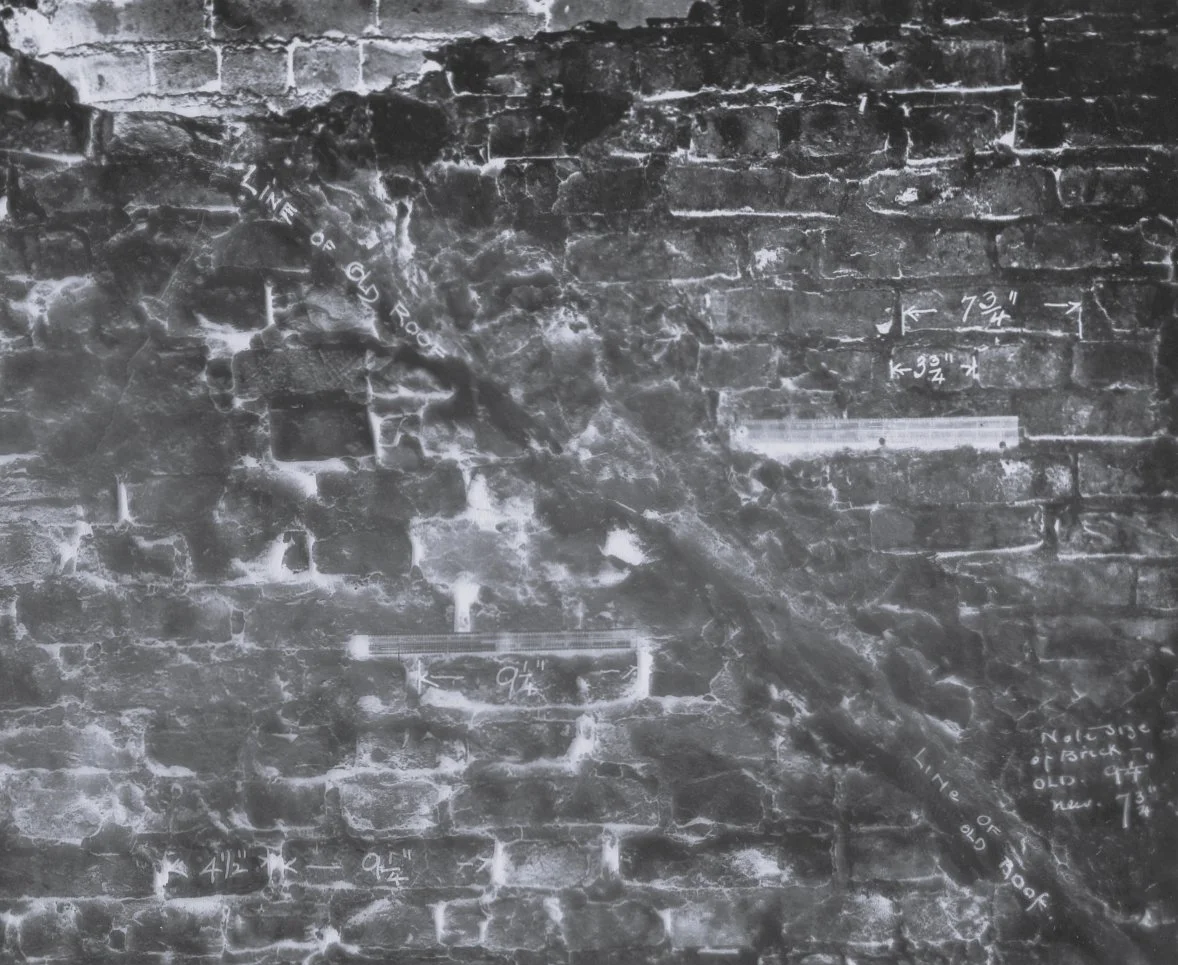
original roof line documented by Mersereau. About 1905. collection of Fraunces Tavern Museum.
Mersereau identified and restored the original roof line after the plaster was stripped from the building’s south wall. He observed that the bricks above the original line were entirely different in measurement from the bricks below the line. [4]
Original masonry on the building’s façade that survives from the 1719 structure includes large sections of the yellow Dutch bricks and three red-brick jack arches on the second floor of the building’s Broad Street side. The façade of yellow Dutch bricks is the sole surviving such exterior in all of New York City from a time when much of seventeenth and early eighteenth-century New Amsterdam, and then New York, was constructed with this material. Large sections of the red brick used on the Pearl Street façade are also original and represent one of the first documented and oldest surviving uses of the red English brick in
New York City.
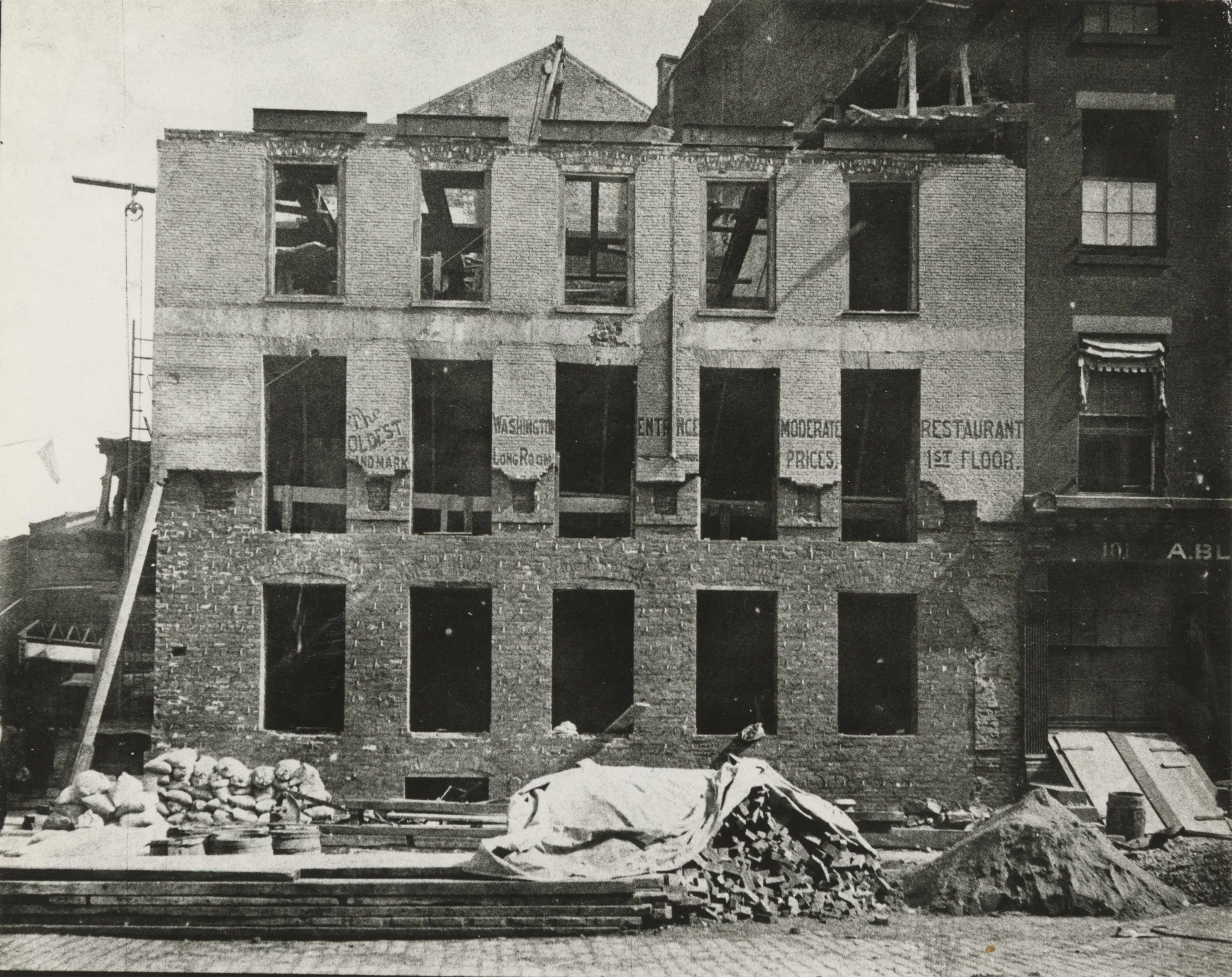
fraunces tavern broad street facade during the Mersereau restoration. large sections of the origingal dutch bricks and three original jack arches were preserved between the 2nd and 3rd floors. About 1905. collection of Fraunces Tavern Museum.
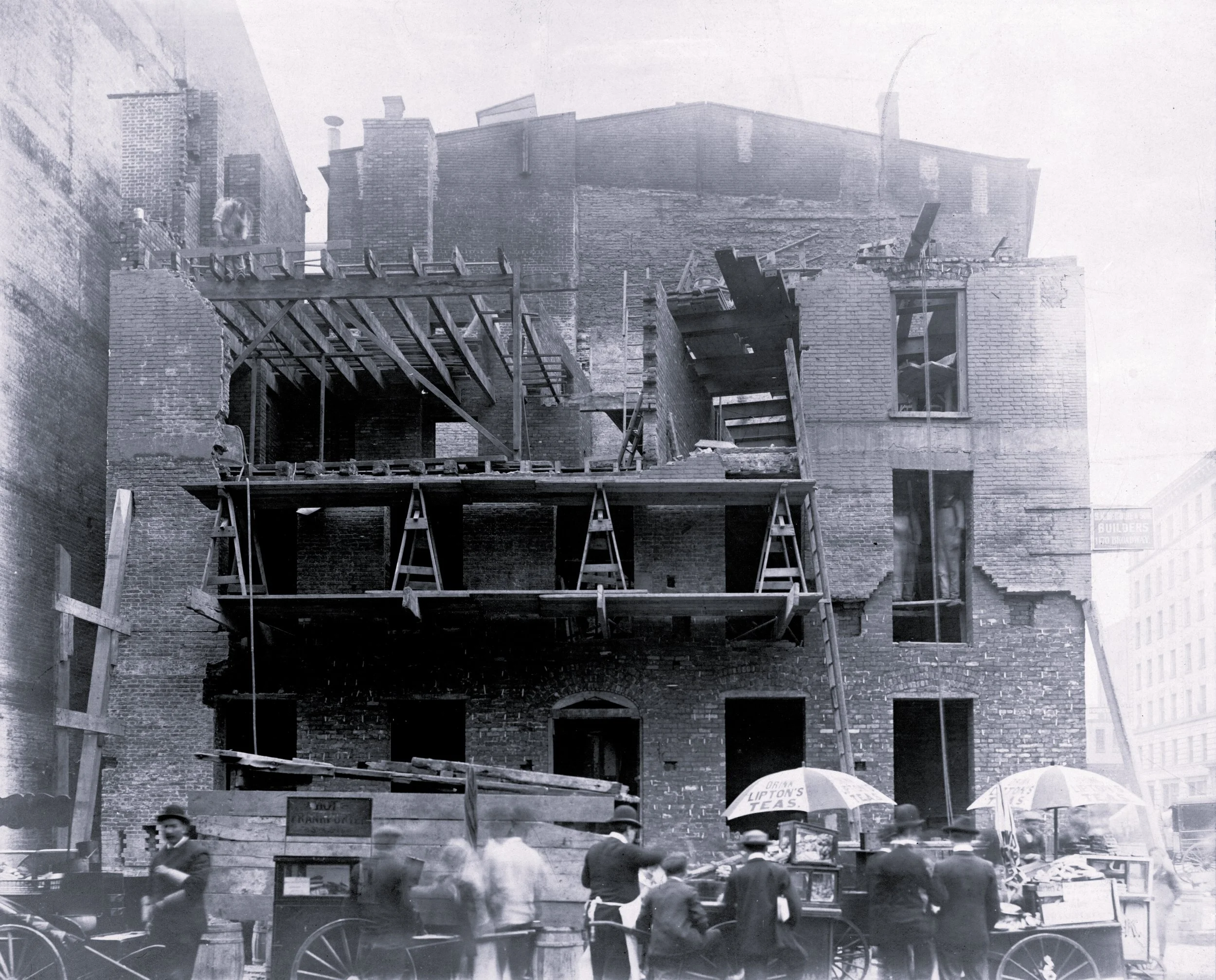
fraunces tavern pearl street facade during the Mersereau restoration. large sections of original english bricks were preserved. About 1905. collection of Fraunces Tavern Museum.
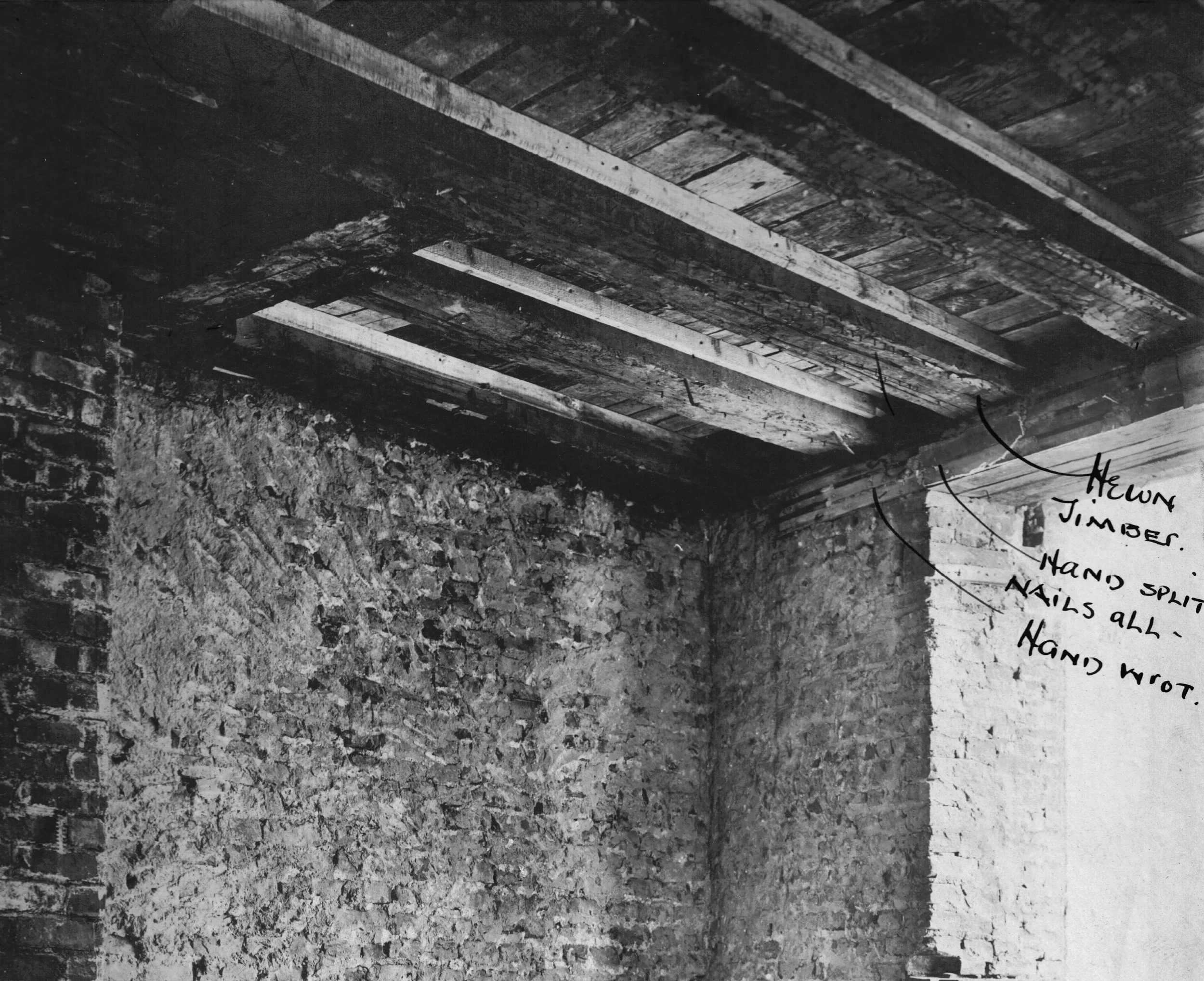
The southwest corner of the Long Room, taken during the restoration. Annotations on the image note hand wrought nails and hewn timbers, all original to the space. About 1905. collection of Fraunces Tavern Museum.
The Long Room remains in its original location with its ceiling and walls still intact. Original beams of the structure may be observed in various exposed areas of the basement, and it is very clear that a tremendous amount of original material remains in situ hidden behind the interior walls of the building.
In undertaking this restoration with an eye to keeping as much historic fabric as possible, William H. Mersereau anticipated the historic preservation movement by several decades. In the Museum’s collection, there are many materials saved by Mersereau, including wood fragments, dust, and paint samples. His personal letters in the Museum’s archives outline his sensitive approach to the building’s restoration and suggests he was a pioneer in this preservation movement.
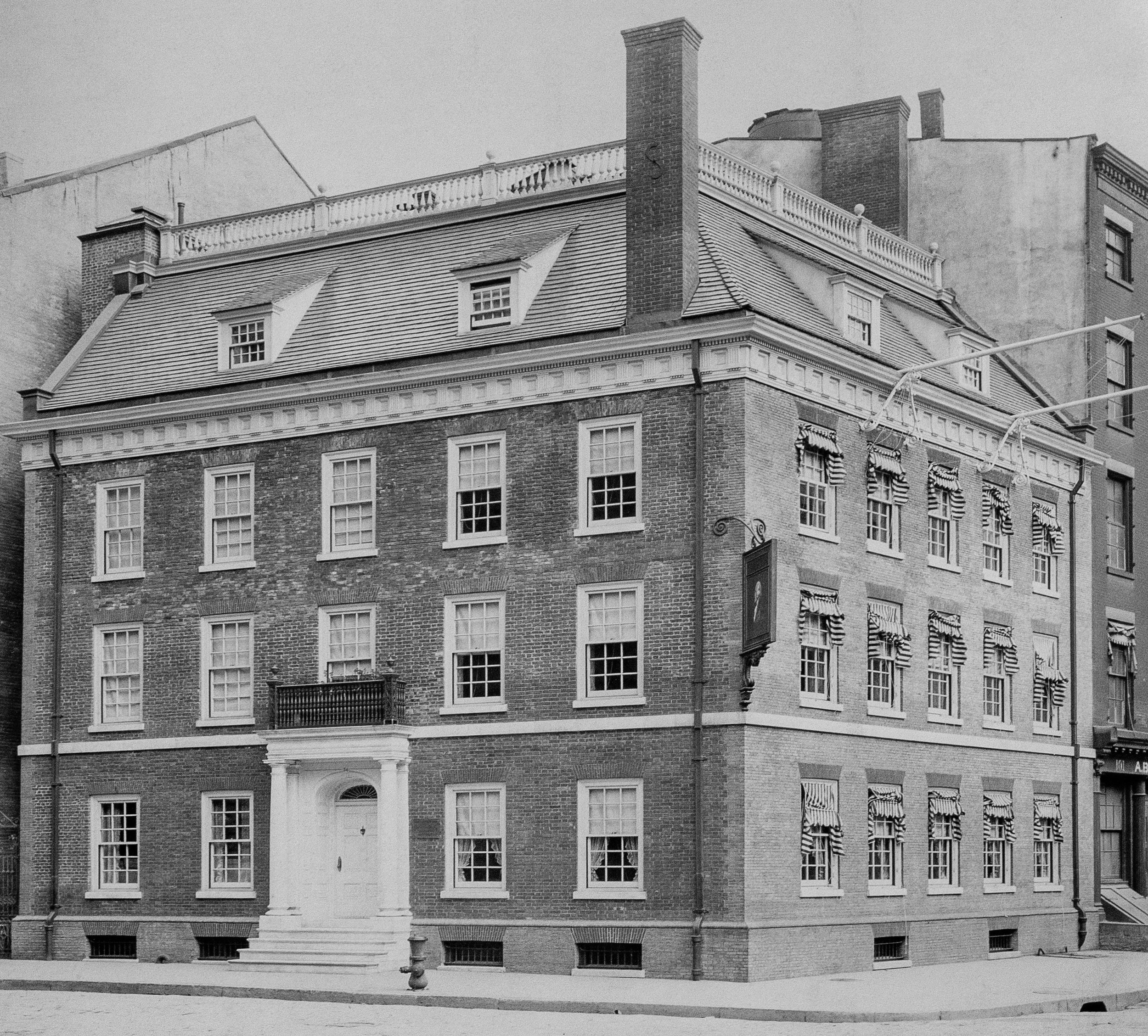
fraunces tavern shortly after its restoration in 1907. collection of Fraunces Tavern Museum.

fraunces tavern today. credit: Fraunces Tavern Museum.
Read more about William H. Mersereau’s preservation philosophy and the restoration of Fraunces Tavern here.
Footnotes
[3] The New-York Gazette, and the Weekly Mercury, March 20, 1775, the American Antiquarian Society
[4] “How Fraunces’s Tavern Was Restored by William H. Mersereau,” The New York Times, March 17, 1907, Section M, Page 11.