Programs & Events Coordinator Armonee Wilkins explores the hidden world of Revolutionary War intelligence and the crucial yet often overlooked role women played within it.

Intelligence was crucial to the outcome of a battle even before it was fought. This was well understood by General George Washington who established a network of spies, couriers, and informants to monitor the movements and actions of the British. Within this network, the role of women was significant, though often invisible, to those who did not take them seriously.
The history of espionage and intelligence gathering by women in the American Revolutionary War, however, is also a story of historical records and sometimes, the lack thereof. Some female spies can be securely linked to the intelligence systems due to existing correspondence, military documents, and pension applications such as that of Ann Bates, who was documented in British intelligence archives and her own 1785 pension application, and Elizabeth Burgin, whose 1779 correspondence is recorded in the Papers of the Continental Congress. Others are not so lucky, like “Agent 355,” who is known only by brief or coded mentions.
The Culper Spy Ring and the Mystery of Agent 355
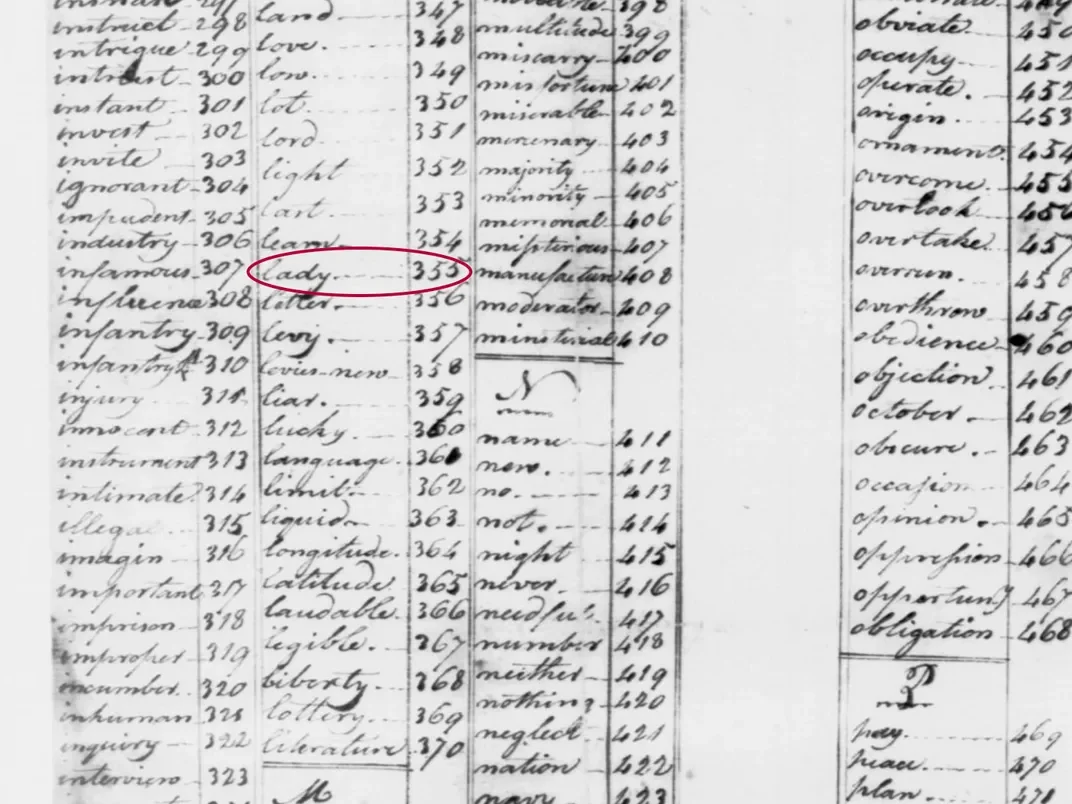
A list of Culper Spy Ring codes, “lady-355” circled in red, courtsey of Library of Congress.
One of the most organized and sophisticated intelligence networks of the Revolution was the Culper Spy Ring, founded by Major Benjamin Tallmadge under General Washington’s orders. The main location of this intelligence network was Setauket, Long Island; they used ciphers and coded numbers to protect their identities. One letter from 1779, written by Abraham Woodhull (whose codename was Culper Sr.) referenced a woman, and reads: “I intend to visit 727 [code for New York] before long and think by the assistance of a 355 [code for lady] of my acquaintance, shall be able to outwit them all.”(1) Although we do not know who Agent 355 was, we do know from this one document that women played a part in intelligence gathering.
Elizabeth Burgin: A Woman Who Left Her Mark
Unlike Agent 355, some women left behind first-hand accounts of their involvement in espionage-related activities. Elizabeth Burgin was instrumental in helping American prisoners of war escape from British captivity. In her letter to Reverend James Calville, dated November 19, 1779, Burgin narrated her escape from the British.(2) She revealed details not only of the measures taken but also their consequences. Specifically, she explained that she had “done what I could for the relief of the prisoners,” but then was “obliged to leave my habitation and fly for refuge to avoid the enemy.” Moreover, she found herself “in a very distressed condition, having left all my effects behind me,” thereby highlighting the price of being engaged in such activities. Her letter, found in the Papers of the Continental Congress (Record Group 360) in the National Archives, is an exception to the lack of first-hand accounts by women related to the Revolution and intelligence gathering.
Ann Bates: A Loyalist Spy with Documentary Evidence
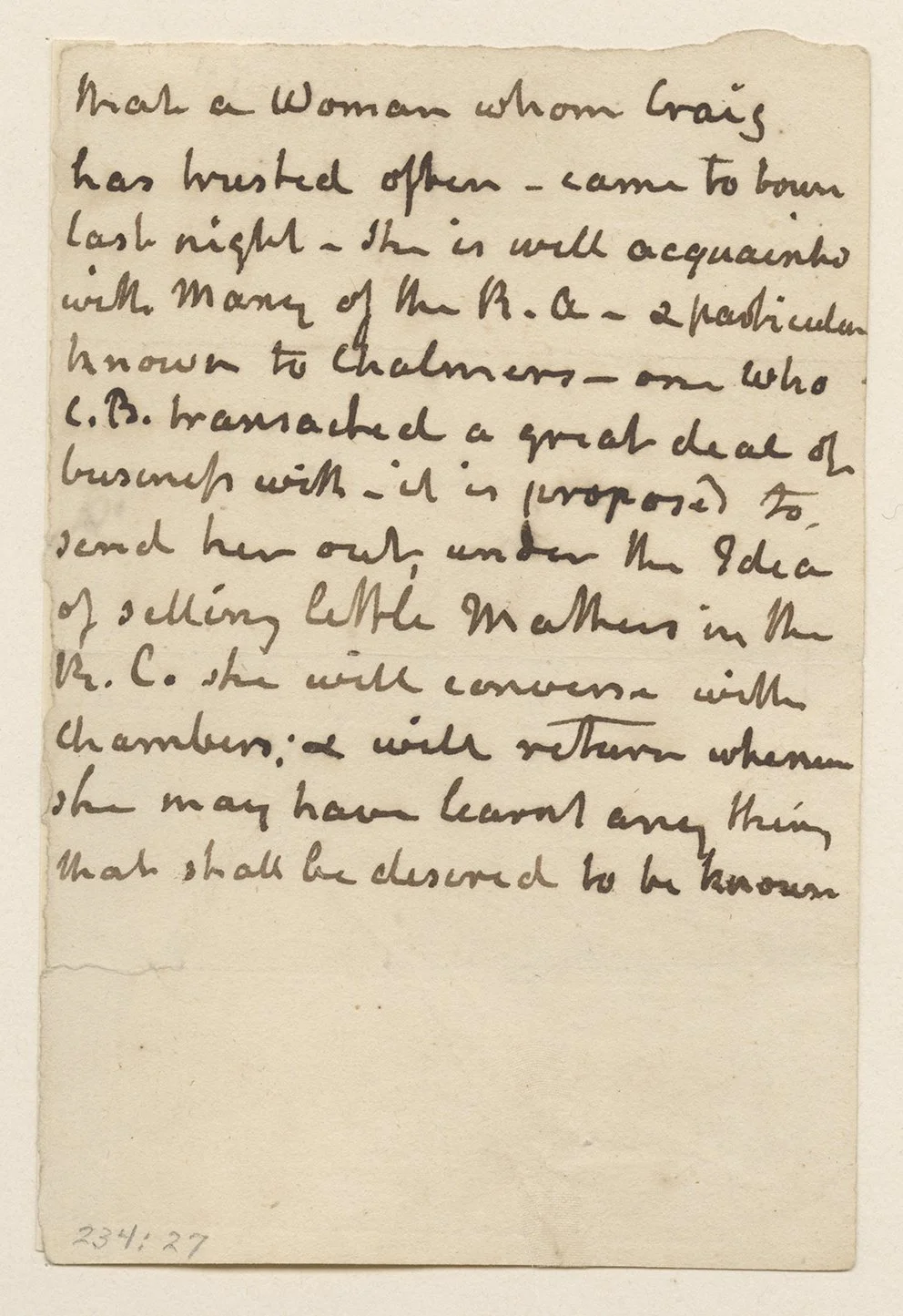
Unsigned/Undated Manuscript Regarding Ann Bates. Henry Clinton Papers. Courtesy of William L. Clements Library
Of the few women spies whose activities are recorded in the historical record, Ann Bates stands out as a brazen and effective operative. A schoolteacher from the Philadelphia area, Bates worked as a spy for the British, travelling through the Continental camps gathering intelligence on troop movements, gun placements, and supply depots. Memoranda in the archives of British intelligence mention her role in reconnaissance missions and her efficiency in gathering information while posing as a small goods vendor, which allowed her to roam around and see the position of the Americans(3). These details were particularly helpful during the Battle of Rhode Island in 1778, when the British wanted to prepare themselves against an attack by the combined forces of the Americans and French on Newport(4). Ann Bates wrote in her petition to the British Treasury in 1785: “I do hereby declare that my service hath been the blessed means of saving the Rhode Island garrison with all the troops and stores who must otherwise have fallen a prey to their enemies.”(5)
Anna Smith Strong: Ordinary Life as a Cover for Spycraft
Anna Strong, a woman from a distinguished Long Island family, was a less prominent yet important contributor to the Culper Spy Ring. Strong, who resided in Setauket, New York, took advantage of her location and status to feed intelligence to the spy ring while under the watchful eyes of British forces. Strong’s most famous contribution to the spy ring came from a common activity given a clever twist: Strong sent messages to fellow spies regarding British movements in Long Island Sound by hanging laundry on a clothesline in a particular pattern(6). This clever use of a common activity allowed intelligence to flow from occupied territory to General Washington’s army without raising suspicion. Aside from the laundry, Strong relayed letters, and offered a haven for other members of these networks, including Abraham Woodhull and Robert Townsend(7). The story of Strong underscores how women, despite being underestimated by military and societal standards, could use their domestic role and social standing to conduct significant espionage activities, demonstrating the intelligence and bravery of female spies during the Revolutionary War.
Conclusion
The records, as they are, reveal women’s involvement in war in an uneven manner. Some women, like Burgin and Bates, are well-documented through letters and other records, while some, like Agent 355 and Anna Strong, are only indirectly mentioned through coded messages. What these records reveal is that women, far from being passive agents, helped in the war by passing on messages, managing the intelligence system, and using the assumptions made about them to move freely through Patriot and British territories alike. While the records may not reveal much about the women, they affirm the importance of women’s intelligence work in the war.
From coded letters to hidden messages on the clothesline, women helped shape the intelligence world of the Revolution. Women's contributions were not merely legend, but fact, and are supported by letters and official military records. As historians continue to find and interpret these records, we learn that the story of America's Independence is also the story of the secret world of female spies, and the women who helped shape the very fabric of America.
Footnotes
II. Samuel Culper to John Bolton, 15 August
Elizabeth Burgin to Reverend James Calville, November 19, 1779,
Elizabeth Burgin to Reverend James Calville, November 19, 1779,
“Unsigned/undated memorandum regarding Ann Bates,” Henry Clinton Papers, William L. Clements Library, University of Michigan.
Christian McBurney, “Ann Bates: British Spy Extraordinaire,” Journal of the American Revolution, December 1, 2014
Ann Bates, pension petition, March 17, 1785, British Treasury Papers, In‑Letters, T1/611, British National Archives.
Alexander Rose, Washington’s Spies: The Story of America’s First Spy Ring (New York: Bantam Books, 2007), 142–144.
Douglas W. Owsley, The Culper Spy Ring in the American Revolution (Washington, D.C.: National Park Service, 2010), 23–25.
Alexander Rose, Washington’s Spies, 147–149.
Bibliography
Samuel Culper to John Bolton (Benjamin Tallmadge), 15 August 1779, The Papers of George Washington, Revolutionary War Series, vol. 22: 1 August–21 October 1779, ed. Benjamin L. Huggins (Charlottesville: Univ. of Virginia Press, 2013), 47–48; Founders Online, National Archives,
Elizabeth Burgin to Reverend James Calville, November 19, 1779, Papers of the Continental Congress, Record Group 360, National Archives; available via DocTeach, National Archives
Christian McBurney, “Ann Bates: British Spy Extraordinaire,” Journal of the American Revolution, December 1, 2014 Ann Bates: British Spy Extraordinaire - Journal of the American Revolution
Ann Bates, pension petition, March 17, 1785, British Treasury Papers, In‑Letters, T1/611, British National Archives.