Seeking Freedom: Judith Jackson’s story
Programs & Events Coordinator Armonee Wilkins explores Judith Jackson’s journey for freedom during the Revolutionary War.
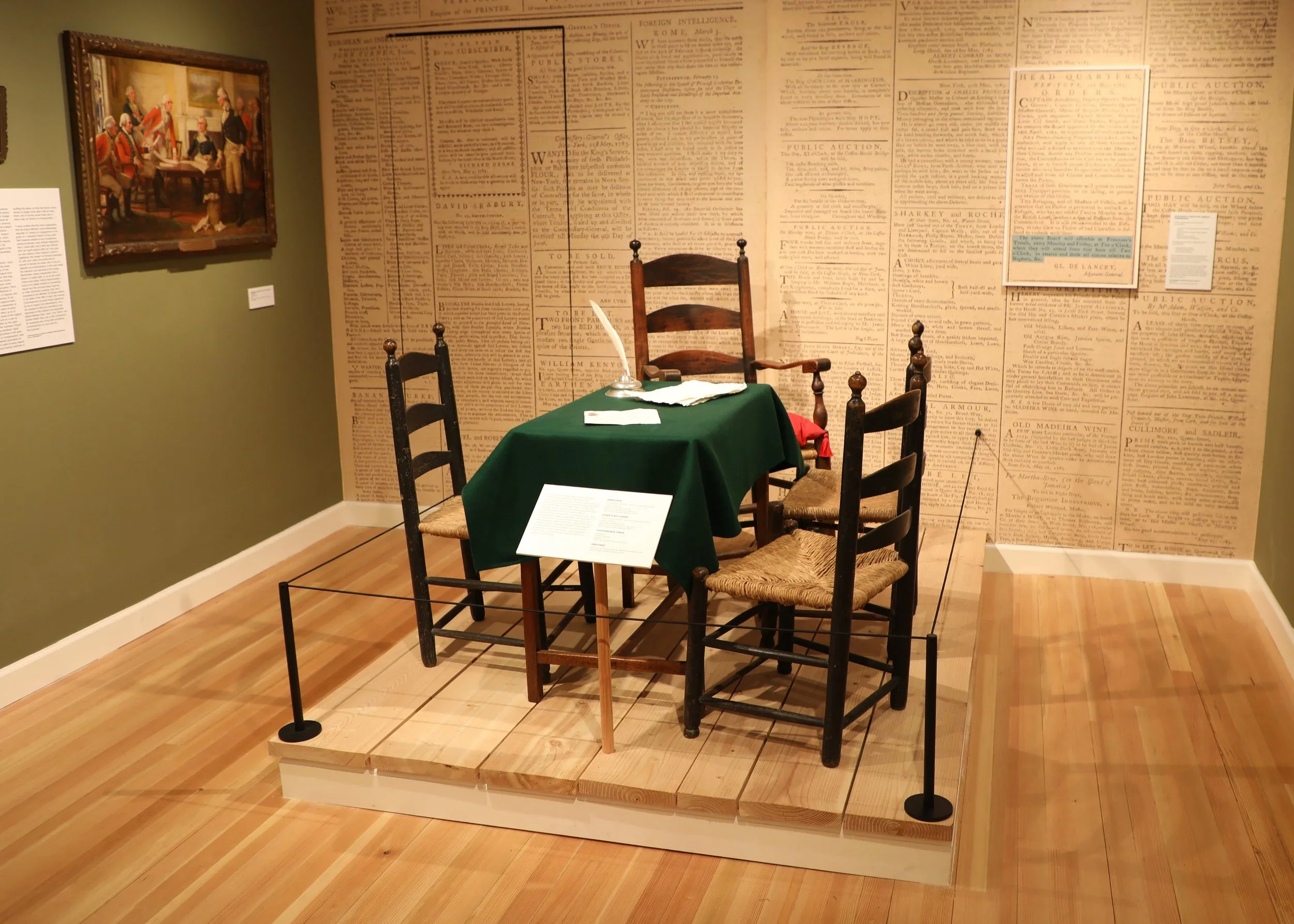
The birch trials at fraunces tavern MUSEUM exhibition
On November 14, 1775, the Royal Governor of Virginia, Lord Dunmore, released a proclamation in Williamsburg that promised freedom for indentured servants and enslaved people [1]. However, to receive freedom they had to fight with the British forces. The British had hoped that their proclamation would cause a disruption on America’s home front. It posed an economic threat which would put the Continental Army at a greater disadvantage [2], with the bonus of gaining more soldiers and skillful workers. Enslaved people were often talented and skillful, with expertise in blacksmithing, shoemaking, distilling and many other trades [3]. The British plan worked to some degree; as many enslaved people ran to join the British, Dunmore’s forces grew by roughly 800 soldiers. Many more escaped to British-owned territories where they were given non-military jobs [4].
Forty-nine-year-old Judith Jackson and her six-year-old child escaped in 1779, four years after the proclamation was released. In May 1779 during a British raiding of Tidewater, Virginia, she took the opportunity to escape and take refuge behind British lines along with more than 500 Black Loyalists [5]. When she arrived in New York, leaders assigned her to work as a personal servant to multiple British officers within the Royal Artillery party, including Lord Dunmore and likely Sir Guy Carleton, Commander-in-Chief of British forces. While behind British lines, Jackson received wages and clothes for the jobs she performed [6]. Along with being a personal servant, she kept military camps clean, which was a vital task as soldiers succumbed to diseases such as smallpox, tuberculosis and measles. For many formerly enslaved people, this was their first time being paid for their services.
Over the span of six years, New York City saw an influx of people seeking to self-emancipate under Lord Dunmore’s Proclamation, with approximately 10,000 living in New York City in 1780. British leaders eventually began to place limitations on the proclamation, stating that only enslaved Black men would be “protected by King George” [7] [8]. British forces believed that enslaved women with children were taking advantage of the law and were becoming a burden to the city, as they could not be used as active soldiers. British General James Pattison expressed in a letter a solution to their obstacle: “The General therefore requests you will be so good as to prevent their passing the North River….” [9]. Despite all the work Judith Jackson and so many others did, they were still met with hostility.
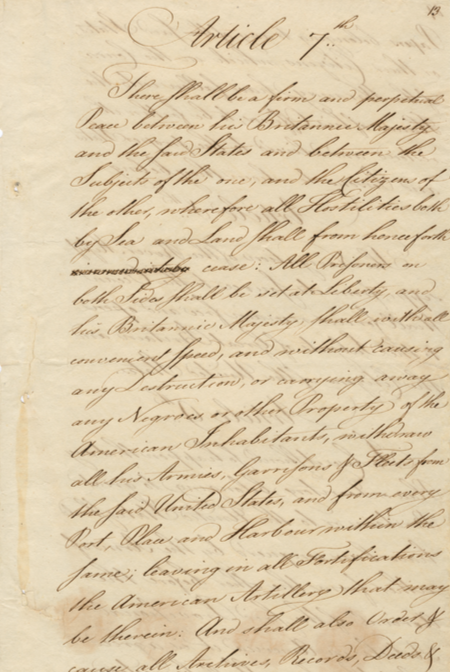
Article Seven of the 1783 Treaty of Paris. Credit to National Archives.
Although fighting continued, particularly in the southern states, the American victory at Yorktown over British forces resulted in a change of government in London, and the beginning of peace negotiations. The Preliminary Articles of Peace, what would eventually become the Treaty of Paris, was signed on November 30, 1782, and ratified by Congress on
April 15, 1783. Article 7 stated that “his Britanic Majesty shall with all convenient Speed, and without causing any Destruction, or carrying away any Negroes or other Property of the American inhabitants, withdraw all his Armies, Garrisons & Fleets from the said United States” [10]. British and American leaders in New York had different understandings of the provision of Article 7. Further, approximately 5,000 people had arrived in New York City to reclaim the individuals they had previously enslaved [11]. Subsequently, General George Washington and Sir Guy Carleton, met on May 6, 1783, to discuss the evacuation of New York City and specifically the implementation of Article 7. This resulted in the Birch Trials, a process in which a joint British and American Commission met at Fraunces Tavern to determine the eligibility of Black loyalists to evacuate with the British Army. The commission was overseen by British Brigadier General Samuel Birch, Commander of the 17th Regiment of Light Dragoons and Commandant of New York, who was appointed by Carleton to oversee the proceedings [12].
In August 1783, Jackson and her child were confronted in New York by Jonathan Eilbeck, a Loyalist Virginia kidnapper who was living in New York at the time who claimed he purchased her from his brother-in-law, John McLean. Prior to Eilbeck and Jackson’s appearance before the Commission, Eilbeck stole Jackson’s clothes and money that she received while working for British officers. He also kidnapped and re-enslaved her daughter back in Virginia. On September 18, 1783, Jackson relayed all this information to Sir Guy Carleton [13].
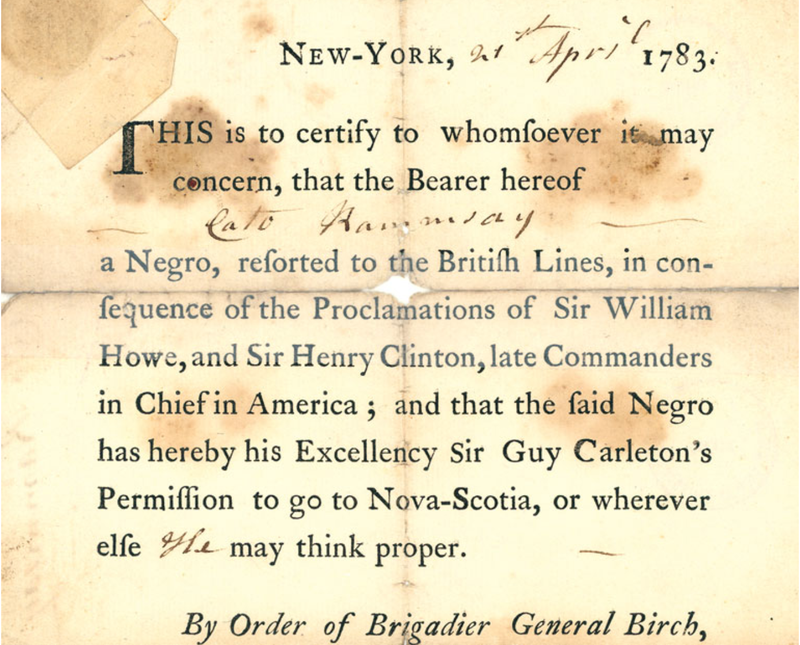
An example of a certificate from Samuel Birch. credit to Nova Scotia Archives.
On September 20th, Jackson and Eilbeck stood before the Commission at Fraunces Tavern. Eilbeck produced a bill of sale dated July 16, 1782 for his purchase of Jackson from McLean. However, Jackson argued, with proof, that she had escaped slavery under John McLean who left for England without her. Subsequently, Jackson had been behind British lines for four years and had obtained a certificate dated June 5, 1783, that allowed her to leave New York City [14] [15]. However, Elibeck identified himself as a Loyalist and British citizen, which further challenged Jackson‘s claim as the Articles of Peace only applied to those enslaved by American Patriots, not Loyalists [16]. Eventually, it was decided that Jackson should be returned to Elibeck [17]. This decision should have forced Jackson to return to Virginia; however, her name is listed in the Book of Negroes, a record produced by the Commission of approximately 3,000 Black individuals, men, women, and children, who were permitted to evacuate New York aboard British ships. Judith Jackson, at the age of 53, is listed as having set sail alone on a ship named Ranger heading to Nova Scotia on November 30th, 1783 [18].
At this time, it is unclear how Jackson managed to evacuate to Canada when evidence suggested she was destined to be re-enslaved in America. Jackson’s history after she set sail was also poorly documented, and it is also unknown what became of her once she arrived at her destination, including if she was reunited with her child. When she arrived in Nova Scotia, she was granted an estimated 20 acres of land; however, records indicate it was never claimed [19]. In Nova Scotia, Black Loyalists established their own communities, most notably Birchtown, known as the largest free Black settlement in North America after the Revolution, as well as settlements in Shelburne, Annapolis Royal, and Digby. Despite receiving smaller and often poorer land grants than their white counterparts, they built homes, churches, schools, and mutual aid networks, laying the foundations for enduring Black communities in Canada.
The Birch Trails exhibition at Fraunces Tavern Museum highlights the complex and often overlooked experience of Black Loyalists, many of whom sought freedom from enslavement by aligning with the British, and their fight for liberty.
Footnotes
Lord Dunmore Proclamation, The Birch Trials at Fraunces Tavern, Fraunces Tavern Museum
African American Service during the Revolution war, American Battlefield Trust
African American Service during the Revolution war, American Battlefield Trust
African American Service during the Revolution war, American Battlefield Trust
Norfolk to Nova Scotia, Colonial Williamsburg
Norfolk to Nova Scotia, Colonial Williamsburg
General Orders December 2,1780, John Graves Simcoe Papers
Norfolk to Nova Scotia, Colonial Williamsburg
James Pattison to Abraham Cuyler, New York Historical Society
The Birch Trials at Fraunces Tavern, Fraunces Tavern Museum.
Norfolk to Nova Scotia, Colonial Williamsburg
Confidential letter and Journals 1776-1784, p556
The Birch Trials at Fraunces Tavern, Fraunces Tavern Museum.
Muster Book of Free Blacks in the Settlement of Birchtown, Library and Archives Canada.
Quoted in Ruma Chopra, Choosing Sides: Loyalists in Revolutionary America (New York: Rowman and Littlefield, 2013), 173; Judith Jackson to Carleton, 18 September 1783, PRO 30/55/81/95, NAUK
Minutes of the Board of Commissioners for Superintending Embarkations, 2 August 1783, PRO 30/55/100, NAUK
J Blucke to Frederick Mackenzie, 20 September 1783, PRO 30/55/82/9, NAUK.
Canada, Library and Archives
Loyalists and land settlement in Nova Scotia. A list compiled by Marion Gilroy. Under the direction of D. C. Harvey, archivist. Published by authority of the Board of Trustees of the Public Archives of Nova Scotia no.4, 1937 p110
Bibliography
“African American Service during the Revolution.” American Battlefield Trust, www.battlefields.org/learn/articles/african-american-service-during-revolution.
Canada, Library and Archives. “Muster Book of Free Blacks in the Settlement of Birchtown.” Library and Archives Canada, 30 Aug. 2022, www.bac-lac.gc.ca/eng/discover/military-heritage/loyalists/book-of-negroes/Pages/item.aspx?IdNumber=1171&.
Carl Leopold Baurmeister, Revolution in America - Confidential Letters and Journals 1776-1784 of Adjutant General Major Baurmeister of the Hessian Forces, ed. Bernhard A. Uhlendorf (New Brunswick: Rutgers University Press, 1957).
“Commissioners of Embarkation at New York to George Washington, 18 January 1784,” Founders Online, National Archives, https://founders.archives.gov/documents/Washington/04-01-02-0038. [Original source: The Papers of George Washington, Confederation Series, vol. 1, 1 January 1784 – 17 July 1784, ed. W. W. Abbot. Charlottesville: University Press of Virginia, 1992, pp. 50–56.]
General Orders December 2, 1780, John Graves Simcoe Papers, William L. Clements Library, University of Michigan.
Gilroy, Marion, comp. Loyalists and Land Settlement in Nova Scotia: A List Compiled by Marion Gilroy under the Direction of D. C. Harvey, Archivist. Publication no. 4. Halifax: Public Archives of Nova Scotia, 1937.
James Pattison to Abraham Cuyler, May 25, 1780 (New York: New York Historical Society Collections, 1875)
“Lord Dunmore’s Proclamation: Finding Freedom.” Lord Dunmore’s Proclamation | Finding Freedom - Museum of the American Revolution, www.amrevmuseum.org/virtualexhibits/finding-freedom/pages/eve-lord-dunmore-s-proclamation.
“Norfolk to Nova Scotia: Judith Jackson’s Crooked Road to Freedom.” Colonial Williamsburg Wax Seal, www.colonialwilliamsburg.org/learn/deep-dives/norfolk-to-nova-scotia-judith-jacksons-crooked-road-to-freedom/.
“Treaty of Paris (1783).” National Archives and Records Administration, National Archives and Records Administration,
“The Birch Trials at Fraunces Tavern.” Fraunces Tavern® Museum